
Ahlan
Welcome to “The Palestine Files” (we know that this name doesn’t tally with that of our domain, “palestinefilm.net”, but to this we say, “ma’alesh” (معليش), necessity dictates and what is for now, will be for now).1 In Palestine the typical welcome is, “ahlan wa sahlan” (أهلاً وسهلاً), which, for friends, is shortened to Ahlan. As with the attempted, but unsuccessful, usurping of the delicacy, “Falafel” (فلافل),2 — in modern Hebrew one also says, “Ahlan” (אהלן) when greeting someone3 — the phrase remains Palestinian to its core:
Ahlan wa Sahlan originates from the strand of Palestinian society that follows a nomadic way of life with its renowned Bedouin-style hospitality.4 The phrase is a combination of two Semitic root stems (explained here semantically). First: Ahlan (أهلاً) is derived from Ahl (أهل) which means: family, kin, or people and implies in context, “you are now with your own people;” “relax, you’re one of us.” Second: Sahlan (سهلاً) is derived from Sahl (سهل) which means: easy or flat land and implies in context, “you have come to a place of ease and comfort.” The “wa” that appears in between Ahlan and Sahlan means, “and.”
We — The Palestine Files, located @ palestinefilm.net — are a collective who collect no money whatsoever and do not even have a bank account to our name. We donate our time because we are not willing to turn a blind eye, or cross to the other side of the street, so-to-speak, in relation to the injustices being meted out to Palestinians. We would like to stress here at the outset that (a) we are pacifists and indeed, this is a prerequisite to becoming a member of this collective and that (b) anything expressed on these pages or linked to from these pages, may not be representative of our principled philosophical stance (please note well its articulation in point a, above).5
Where to begin? Well, in the case of addressing The Question of Palestine by way of “The Palestine Files”, the beginning is the best. There is no gain in complicating affairs, this is not a work of fiction after all, it is rather, a factual record of serial abuse, betrayal, dispossession and unfettered western double standards. Therefore, “the files” on this site are set out chronologically (see the following section for the twelve-part timeline).
Palestine, a history
The sub-sections below introduce the dozen elements of “The Palestine Files” as curated by this collective.
01. Biblical tomes
In the Bible, Palestine is generally considered to have been called Philistia (which was part of the land of Canaan, inhabited by various peoples including the Philistines).6 In recent times there has been much controversy over usage of “Ancient Palestine.”7
02. Saladin
Upon the capture of Al Quds Al Arabi (a.k.a., El-Quds and Jerusalem), Saladin reached out to the Jews who had been evicted by the city’s Christian leaders and offered them the opportunity to resettle in the city. Notably, the Jewish residents of Asqalān responded positively and relocated.
03. The Ottoman era
During this time the region was generally peaceful and all three religions of the book lived harmoniously (for the most part) together in “The Holly Land.” Those of all three faiths spoke and communicated in Arabic.
04. 1880-1917
The rise of Zionism and the duplicity of the colonial imperial powers (in particular the British). Fundamentally those coming to Palestine from Europe fetched with them political and legal practices that were by then ingrained within the institutions of nation states (i.e., legalese relating to tenancy and land ownership rights). The McMahon–Hussein correspondence, the Sykes Picot Agreement and the Balfour Declaration are all covered in meticulous detail.
05. Mandate Palestine
Following on from the 1917 Balfour Declaration, things only got worse and incrementally worse. This was a period of betrayal, dispossession and Zionist terrorism (e.g., Irgun, Lehi, Haganah and Palmach). It ended with the forced expulsion of a great many Palestinians from their home and land — the nakba — and the creation of the state of Israel upon the indigenous lands of the Palestinian people on May 14, 1948.
06. The 1950s
Forced expulsions continue and the “Suez Crisis” (a.k.a., the second Arab–Israeli war) took place.
07. The 1960s
The Palestine Liberation Organisation was formed and the 1967 Arab–Israeli war (June 5–10, 1967) took place.
08. The 1970s
Headline grabbing acts, Black September and oil as a political weapon.
09. The 1980s
The atrocious massacres of Sabra and Shatilla and the first Intifada begins in the Occupied Palestinian Territories.
10. The 1990s
Oslo, the futile idea of “two states,” Red Lines and Road Maps.
11. The 2000s
Illegal settlements proliferate and the Occupied Gaza Strip becomes the world’s largest prison (de facto and de jure).
12. October 2023 to date
A live-screened genocide, settler terrorism and the beginnings of ‘Greater Israel’?
Other matters
In addition to “The Palestine Files,” this website covers several other things:
- Solidarity — This section provides links to various campaign groups the cover or concentrate on Palestine.
- Happenings — This section provides links to good sources of news on current affairs pertaining to Palestine and, selected long-form articles on Palestine.
- Imagery — This section provides an array of images, old and new, artistic and graphic etc. Some of these are our own, others are borrowed, duly acknowledge and cited and, to the best of our knowledge, are of the Creative Commons genre.
- Cartography — This section provides a catalogue of maps of Palestine and its environs. As with pictures, maps speak volumes and often depict truths that to some are quite inconvenient.
- Reading lists — This section provides an annotated bibliography on “The Question of Palestine,” alongside book reviews that are mostly third-party and largely extracted from peer-reviewed academic journals.
Solidarity
Solidarity comes in many forms, be it standing together at protests, marching together on demonstrations or raising awareness on the given matter. With regard to Palestine, notable symbols of solidarity include the flag (yes indeed as it is often banned), the key (symbolising the inalienable “right of return”), the keffiyeh, the character, “Hanthala” and the watermelon. Solidarity with Palestine is synonymous with being resolute, steadfast and is encapsulated in the concept of “Ṣumūd” (which is explained below).


What is essential to understand and to acknowledge etcetera, is that the Palestinians are the indigenous peoples of Palestine. Palestinians comprise those of Jewish, Christian and Muslim faiths (amongst each of these confessional cohorts stand agnostics and atheists).
The flag
The national flag of Palestine (علم فلسطين — “Alam Filasṭīn”) is a tricolour of three equal horizontal stripes, from top to base: black, white, and green and these three stripes are overlaid by a red triangle issuing from the hoist (widest) outwards (tip). The Palestinian flag displays the pan-Arab colours that were first combined as such during the 1916 Arab Revolt. Since then and pre-dating the Balfour Declaration, the Palestinian flag has stayed exactly the same (steadfastly so). For the graphic artists: black is black (000000), white is white (FFFFFF) but red is: #EE2A35 and green, representing the fertile Palestinian crescent, is: #009736.


The flag was flown during the (British) Mandate Palestine times including the 1936–1939 Arab revolt. It became a symbol of global resistance following the 1964 formation of the Palestine Liberation Organisation. Alongside the keffiyeh and more latterly the watermelon.
Keys
The Palestinian key symbolises homes and property lost in the 1948 Nakba, when more than half of the population of Mandatory Palestine were ethnically cleansed by Zionist militias as part of the 1948 forced Palestinian expulsion. Until this day, Palestinians have been denied the right to return. The key is considered to represent the desire to return and reclaim lost properties. In many instances, including some of the pictures here, the keys depicted are the actual keys to homes owned but since 1948 have been confiscated etc.
In 1948, Zionist military forces expelled at least 750,000 Palestinians from their homes and lands in what became known as the Nakba (“catastrophe” in Arabic). Those people took their keys with them, sure they would return. Many Palestinians still hold onto the keys to their original homes as a symbol of their hope and determination to return one day. These keys have been passed down several generations and are kept as a symbol of Palestinians’ right to return – a principle enshrined in international law that grants individuals the right go back to their homes of origin.
We here at “the files” admire the late Robert Fisk, his article here on keys and a ‘museum’ in Shatila refugee camp (Lebanon) is rather jaded, but an insightful read nonetheless, “I spoke to Palestinians who still hold keys.”

In the sketch below, notice the key on a piece of barbed wire worn as a kind of emblematic necklace.


The keffiyeh
The Palestinian keffiyeh depicts a fishing net, solid bands for historical trade routes and leaves of the cherished, stoic olive tree. (There are of course other interpretations and contemporary dangers of sporting it.)

In the 1930s, the — black-and-white keffiyeh — became a symbol of Palestinian identity on par (almost) with the flag. This is because, during the 1936–39 Arab Revolt against the occupying British colonial powers, the keffiyeh was used to conceal the identities of protestors from authorities. When British authorities attempted to ban the keffiyeh, Palestinians wore the garment en masse as a show of unity, even in urban areas, where the keffiyeh gradually replaced the (more upper class) fez.
The keffiyeh gained further prominence in the 1960s when Yasser Arafat, leader of the Palestine Liberation Organisation (PLO), began wearing it in public appearances and at diplomatic meetings. Cleverly, Arafat arranged his keffiyeh in such as way as to resemble the map of “Palestine.”

Between 1967 and 1993, Israel banned the Palestinian flag in Occupied Palestine and in response, wearing a keffiyeh became a way for all Palestinians to demonstrate that their national identity. To this day, and across the world authorities seek to vilify and ban the wearing of the keffiyeh.
Hanthala

“Hanthala” is the character was created in 1969 by political cartoonist Naji Al Ali, and first took its current form in 1973. Hanthala became the signature of Naji Al Ali’s cartoons and remains an iconic symbol of Palestinian identity and defiance. The character has been described as “portraying war, resistance, and the Palestinian identity with astounding clarity”. The name comes from the Arabic word for the colocynth — called “Hanthal” (حنظل) in Arabic — a perennial plant native to the Levant, which bears bitter fruit, grows back when cut, and has deep roots.


The watermelon 🍉
The watermelon (بطيخ – Baṭṭīkh) has been used as a symbol of Palestinian perseverance and resistance (see below) in protests and works of art, representing the Palestinian cause in the context of the Israeli–Palestinian conflict. Watermelon symbols started being used as such in response to Israeli suppression of the display of the Palestinian flag after the 1967 War. If it is not already, it becomes apparent that the watermelon has the same colors as the flag: green and white on the outside, red on the inside with jet black (edible) seeds.

The concept of Ṣumūd
Ṣumūd (صمود) can be translated as “steadfast perseverance” and originates from the Arabic verb (صمد) that means, “to defy, brave, withstand.” The Arabic verb “Sa-Ma-Da” (صَمَدَ) is a Form One Triliteral Verb with the root being: ص م د (from right to left: ṣa-ma-da), and translates to, “to withstand, hold out, persist, or head towards.” Importantly and contextually, Sumud is also a Palestinian cultural value, ideological theme and political strategy that emerged in the wake of the 1967 Arab–Israeli War. It manifests amongst the Palestinian people as a consequence of their oppression and the resistance they exhibit against and towards the occupation.
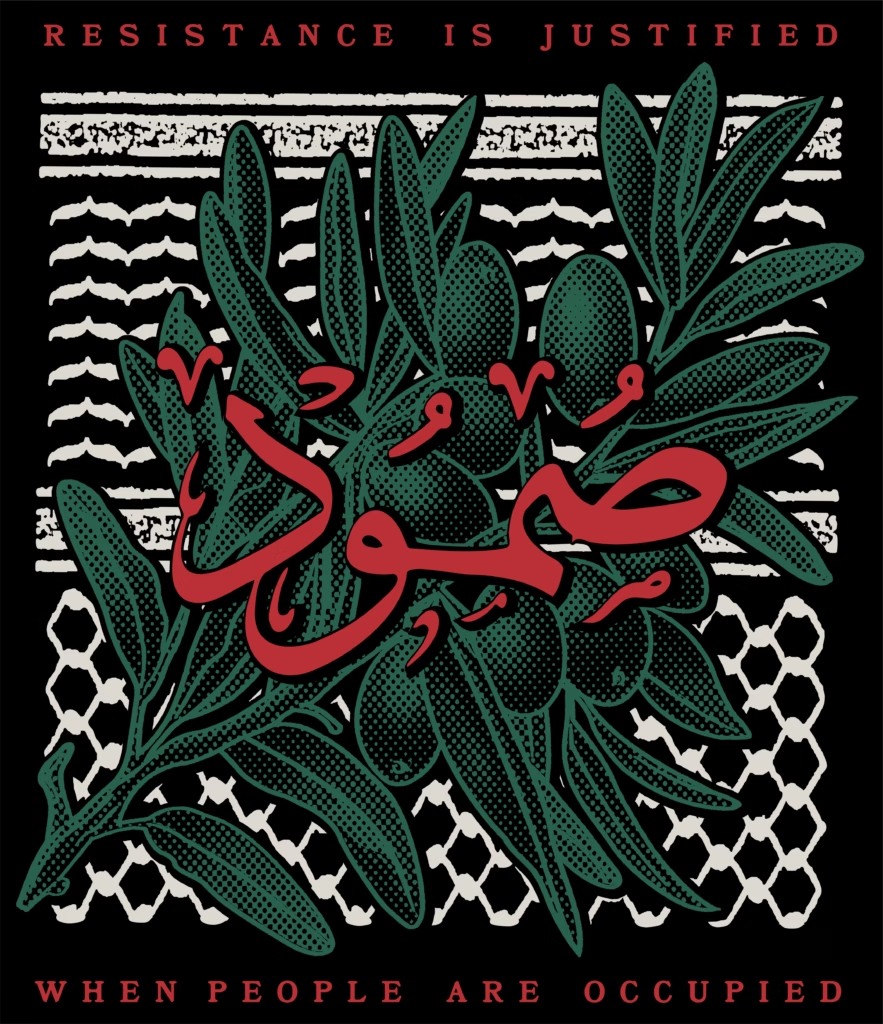

Shop in solidarity
Not from us, but links to worthy places:
Visit in solidarity

B’Tselem — is the “Israeli Information Center for Human Rights in the Occupied Territories.” It strives for a future in which human rights, liberty and equality are guaranteed to all people, Palestinian and Jewish alike, living between the borders of Jordan and the Mediterranean Sea.
Electronic Intifada
Happenings
This section provides links to good sources of news on current affairs pertaining to Palestine and selected long-form articles on Palestine; a few are here listed:
British veterans killed in Gaza were heroes
2026 | BBC et al.
The three Britons — John Chapman, 57, James Henderson, 33, and James Kirby, 47 who were all former servicemen — were part of World Central Kitchen’s security team; a humanitarian organisation that was suppling food to Palestinians under draconian siege conditions.
Article in full ➔
Israeli soldiers bulldoze Allied graves
2026 | Sharon Zhang | Truthout
sfsdfdfd
October 7 controversies: beheaded babies & systematic rape
2025 | Electronic Intifada, The Intercept et al.
sfsdfdfd
Israeli settlers terrorise Occupied Palestine
2026 | The Guardian et al.
sfsdfdfd
Imagery
This section of the website provides an array of images, old and new, artistic and graphic etc. Some of these are our own, others are borrowed, duly acknowledge and cited and, to the best of our knowledge, are of the Creative Commons genre.
Cartography
This section provides a catalogue of maps of Palestine and its environs. As with pictures, maps speak volumes and often depict truths that to some are quite inconvenient. Indeed, maps too can act as modes of solidarity, passively but profoundly impacting the narrative; they constitute historic factual documentation that cannot be glossed over however hard some painters of propaganda may try.


Reading lists
This section provides an annotated bibliography on “The Question of Palestine,” alongside book reviews (mostly third-party and largely extracted from peer-reviewed academic journals). Two of the collection are here:

Source: “The Question of Palestine” (PDF).

Source: “Returning to Haifa” (PDF).
The video below contains an interview with Ghassan Kanafani, the above author, who at the time (1970) edited several Popular Front for the Liberation of Palestine (PFLP) publications that were distributed out of Beirut. Back then the PFLP was headed by George Habash; a Christian Palestinian who always saw the two-state solution for what it was.
غسان فايز كنفاني


Footnotes
- The most common Arabic equivalent for “what will be, will be” (i.e., “Que Sera, Sera”) is, “Al-maktoub maktoub” (المكتوب مكتوب), which literally translates to, “what’s written, is written,” conveying like the English phrase a sense of fate, destiny or inevitability. It should be noted that the grammatically correct Italian is actually, “Che Sarà Sarà.” A literal translation in Arabic is something like, “Ma Sayakoon, Sayakoon” (ما سيكون، سيكون) and in Palestine you’d most likely hear, “Sho ma kan, ykoon” (شو ما كان، يكون – whatever happens, happens). ↩︎
- As one might say when consuming this anywhere in the world, “Zaaki” (زاكي – delicious). The food as it is constituted today originates from Palestine and its first mention in print was in a 1939 edition of The Palestine Post, that raved about freshly fried falafel balls served in Levantine flatbread with a tahini dressing. ↩︎
- Modern Hebrew has only been used as an everyday spoken language since the rise of the European Zionist movement so, around the start of the 20th c. by actors like Eliezer Ben-Yehuda. Prior to that Jews in the Middle East spoke Arabic and Jews in what is today Iran, spoke Farsi. ↩︎
- Some indigenous Palestinians were nomadic — moving around with liberty in the land of Palestine — others were (until forcibly expelled, and presently awaiting to return; an inalienable right enshrined in International Law: UN General Assembly Resolution 194) and are (those that remain) urbanites living in villages, towns and great seats of culture like: Bethlehem, Haifa, Al Khalil (Hebron), Jerusalem, Jericho, Nablus and Nazareth. UN Resolution 194 was adopted towards the 1947–1949 Palestine war in which Zionists were seeking to take Palestine from the Palestinians. The Resolution defines principles for reaching a final settlement and returning Palestine refugees to their homes. Article 11 of the resolution resolves that Palestinian “Refugees wishing to return to their homes and live at peace with their neighbours should be permitted to do so at the earliest practicable date, and that compensation should be paid for the property of those choosing not to return and for loss of or damage to property which, under principles of international law or equity, should be made good by the Governments or authorities responsible.” ↩︎
- As was once said, more or less, by J. E. Steinbeck, “I believe: that the free, exploring mind of the individual human is the most valuable thing in the world; this I must campaign for: the freedom of the mind to take any direction it wishes, undirected; this I must campaign against: any idea, religion, or government which limits or destroys the individual.” ↩︎
- The Philistines appear in the Hebrew Bible (a.k.a., “The Old Testament”) quite a lot. The name “Palestine” (Greek: Palaistinē; Arabic: Filastīn) derives from the ancient Philistines (Peleset), people who settled in parts of modern day Palestine after sailing there from the Greek islands (12th century BCE). References to the Philistines have been noted in Assyrian and Egyptian records and in the later works of Herodotus (5th century BCE). This group of people were first attested to having been in today’s Palestine in reliefs at Egypt’s Temple of Ramesses III (c. 1186–1155 BC), where they are referred to as, “the Peleset” — cognate with Semitic-language “Peleshet” and parallel with Assyrian-language (Akkadian) “Palastu,” or “Pilišti.” ↩︎
- See, for example: Williamson, H. (2026, March 3). Open University U-Turns on ‘Ancient Palestine’ Ban After making a commitment to a pro-Israel lobby group. Novara Media. novaramedia.com/2026/03/03/open-university-u-turns-on-ancient-palestine-ban/ ↩︎